Showing posts with label green architecture. Show all posts

Feb 6, 2012

Fighting Climate Change in Vermont, One Net-Zero House at a Time


We are in the middle of one of the warmest winters in memory, with a noticeable lack of snow. Many are still cleaning up from Tropical Storm Irene, which hit a state not used to dealing with hurricanes and flash floods. As these examples of extreme weather events grow more common, fewer people are doubting that climate change is affecting Vermont in very real, measurable ways.

A new exhibit is now open at the ECHO Lake Aquarium and Science Center that explores the impact of climate change in New England. Seasons of Change: Global Warming in Your Backyard is an interactive travelling exhibit that will be at ECHO until March 25, 2012.

You may think you know what to expect with global warming, but this exhibit will open your eyes to much more. Developed by members of the New England Science Center Collaborative and Brown University, Seasons of Change looks at how climate change is affecting things in Vermont like invasive species, foliage, maple products, fishing and more.

This is a daunting challenge, but we are rising up to meet it.

This week we will be attending the Better Buildings by Design conference, an annual event hosted by Efficiency Vermont that brings together architects, engineers and builders for 2 full days of interactive learning about building efficiency. Global warming is often thought of as the result of pollution from cars and power plants, but buildings are actually an equal culprit. Nationwide, buildings are responsible for one third of all greenhouse gas emissions, equal to that of transportation and industry.

At Truexcullins, we are working for a better climate future by designing net-zero energy buildings. These buildings produce as much energy as they use. By intelligently managing the energy demands and eliminating the need for fossil fuels, we can reduce greenhouse gas emissions and slow the spread of global warming.

One of our recent green homes will be recognized with an award from Efficiency Vermont at this week's conference. This net-zero energy home in Calais, Vermont will be receiving the award for Best of the Best in Energy-Efficient Residential New Construction. TruexCullins Principal Lee Grutchfield was the architect on the project, with general contractor Hobie Guion and energy consultant Andy Shapiro of Energy Balance, Inc.


Congratulations to the entire project team!  We have more of these projects in the works, and we look forward to working with all of our colleagues and consultants to develop net-zero energy buildings that help to solve our climate challenges. 

Sep 30, 2011

Solar Decathlon Review, day 3: Our Favorites


This Sunday, October 2nd is the final day for public viewing of the 19 student-built solar-powered homes of the Solar Decathlon on the National Mall.  The excitement is building as the points are adding up and a winner is coming into focus.  Tomorrow, Saturday Oct 1st, the winner will be announced, the team that has accrued the most points across the 10 categories in fields such as architecture, engineering, energy and affordability.

Many of the houses incorporate some of the technologies and green design strategies that I described in yesterday’s post, but the best houses are the ones that bring it all together beautifully.  Here are 3 of our favorites:

LIVING LIGHT by the University of Tennessee
This house is based on the cantilever barns of Southern Appalachia, with an open plan anchored by a dense core at each end.  But the real intelligence is in the envelope.


The all-glass north and south elevations consist of a 16” thick double-façade system, with a fixed plane of glass on the exterior, alternating fixed glass and full-height casement windows on the interior, and internal blinds.  In the winter, the air space within the south-facing façade collects heat that is directed to an ERV, supplying the home with preheated air.  In the summer months, the system works in reverse, drawing fresh air from the north façade by the ERV and pre-cooling it before it hits the ductless mini-split units.  Exhaust air is directed through the south façade to cool the cavity and reduce heat gain.

Energy is generated from a 10.9 kW rooftop array of cylindrical PV panels.  Look closely: those are cylindrical tubes that make up the canopy over the south façade.  Thin-film PVs are wrapped around these tubes, collecting sunlight from any angle.  There is no need to worry about the correct angle of the panels here, since the cylinders absorb sunlight from all directions.
You can get more info on the University of Tennessee solar house from the project website, livinglightutk.com, including some great detailed descriptions and explanations of the smart façade, roof top array, and more, at: livinglightutk.com/smartsystems/

WATERSHED by the University of Maryland
This house is all about the conservation and management of our water resources.  Coming from the Chesapeake Bay area, the students of the University of Maryland drew inspiration from the 64,000 square mile Chesapeake Bay watershed and have designed a house that addresses the storm water issues that threaten this fragile ecosystem.

The form of the house is defined by two rectangular modules with a split-butterfly roof.  A 9.2 kW solar PV array covers one side, and a green roof tops the other.  Rainwater is captured from the roof and directed to a series of captured wetlands, where the water is naturally filtered by plants until it can be pumped out for reuse as irrigation water.  Greywater from the shower is also directed to the constructed wetlands for reuse.


Finishes include thermo-treated exterior wood siding of poplar and ash, and recycled concrete countertops.

This is the 4th time the University of Maryland has competed in the Solar Decathlon, and their experience is paying off: as of this writing, they are currently in 1st place.

More information on WaterShed can be found at the University of Maryland project website, 2011.solarteam.org.


SELF RELIANCE by Middlebury College
This is the first year that a Vermont school is competing in the Solar Decathlon, and as a Vermont architect, I’m happy to say that Middlebury College has put up an impressive first showing.

The Middlebury house, dubbed Self Reliance, is a modern take on the traditional Vermont farmhouse.  It hits so many of the themes we all associate with the Vermont lifestyle: natural materials, sustainable food production, and family-friendly spaces.


Wood floors were harvested from Sugar Maple trees on the Middlebury campus.   The kitchen floor and island countertop is made of local Vermont slate.  And the children’s bedroom furniture is made by our friend Lincoln Brown of Modern Vermont.

While most of the other houses on the Mall covered every possible surface with spray foam insulation, Middlebury came out firmly against the stuff and instead went with a completely cellulose-insulated envelope. They explained their approach this way:  “Conventional insulations such as fiberglass or spray-in foam contain particles hazardous to all forms of life. They are also non-biodegradable and require tremendous amounts of oil and energy to process.  On the other hand … Cellulose insulation is safe, low-energy, cheap, and – most importantly – natural.”

Self Reliance is focused on personal, sustainable food production.  A greenhouse wall in the kitchen is not much more than a system of shelves for growing potted vegetables and herbs, but it is centrally located and promotes home-grown healthy eating. By making this such a prominent feature of the house, the students are trying to highlight the connection between local food production and energy use.

This is a very family-friendly house, designed for a family of four, with a division of public and private spaces.  Most of the other schools seem to struggle with the space constraints of the competition, designing homes under 1,000 square feet with murphy beds, movable walls, and multi-purpose spaces.  Many don’t even have real bedrooms.  The Middlebury house actually has TWO bedrooms, and a play loft accessible by a metal ladder.

Middlebury is doing very well for this being their first time in the Solar Decathlon.  They scored 4th in the prominent Architecture category, and came in 1st place for “Home Entertainment”.  This is one of those categories that aims to show that these are real, livable homes, so the students had to throw a movie night and 2 dinner parties.  They probably won due to the delicious localvore meal they prepared, which their guests praised as being very “Vermonty”.

On Wednesday, Metropolis Magazine called Self-Reliance one of “the two most striking projects at the Decathlon”.  They described it as “a warm and straightforward modern version of a traditional New England home that beautifully uses native Vermont materials.”

You can read more about Self Reliance on the Middlebury College project website, solardecathlon.middlebury.edu

Congratulations to the Middlebury team and to all the teams at the Solar Decathlon, and good luck tomorrow as the grand prize winner is announced!

Sep 29, 2011

Solar Decathlon Review, day 2: Products and Process


There are a wide range of projects at the Solar Decathlon, where schools from 13 U.S. States and 5 countries are each building their own version of the ideal net-zero energy solar powered home.

The houses are built for different climates, cultures, and user groups, depending on the location and type of school competing.  But one thing is common for all the teams:  they have spent a lot of their own energy researching the best products and developing new design strategies for solar powered buildings.  I go to the Solar Decathlon to discover what the future holds, and I found plenty of new green products and design features.  Here are my Top Ten:

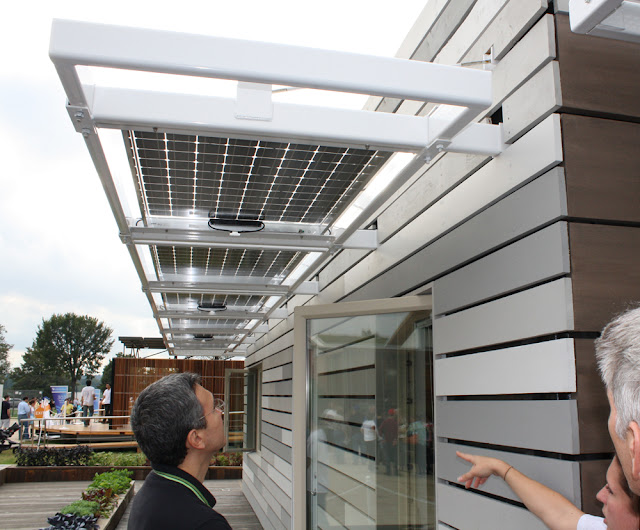
1.   Bi-facial solar panels:   These solar panels collect energy from both sides, collecting direct sunlight from above as well as reflected light from below.  It is one of the newest types of solar panels to hit the market, generating up to 30% more power.

The Solar Homestead by Appalachian State University made the most of this technology, with a huge outdoor space covered with a canopy of bi-facial solar panels set within a beautiful wood structure.  Every team distributed “take-aways” or brochures to those people waiting in line to tour the houses, and Appalachian State had a real clever way of tying their marketing materials into the design of the solar array.  Their brochure folded up into an origami hat, with a reflective silver exterior.  As crowds of people walked beneath the bi-facial solar canopy, light was reflected off their silver heads back up to the panels above, generating more energy, potentially pushing Appalachian State over the finish line.


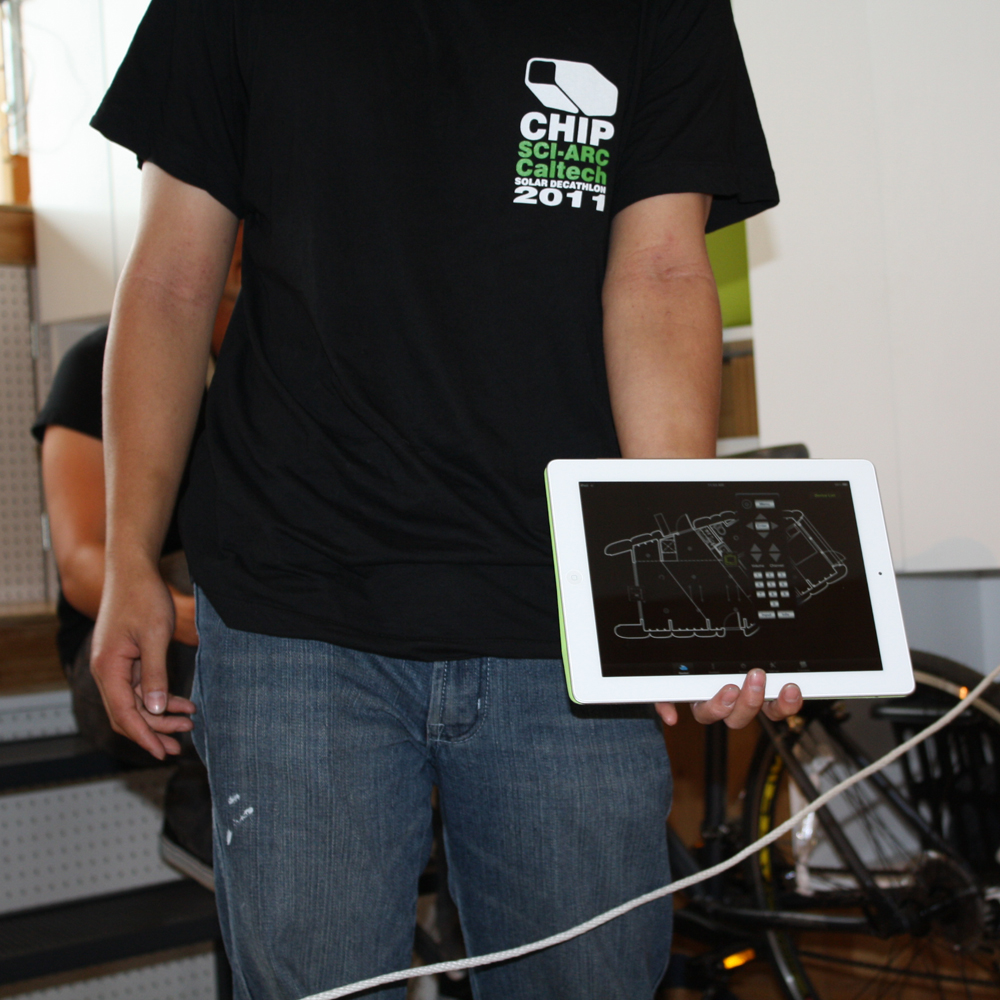
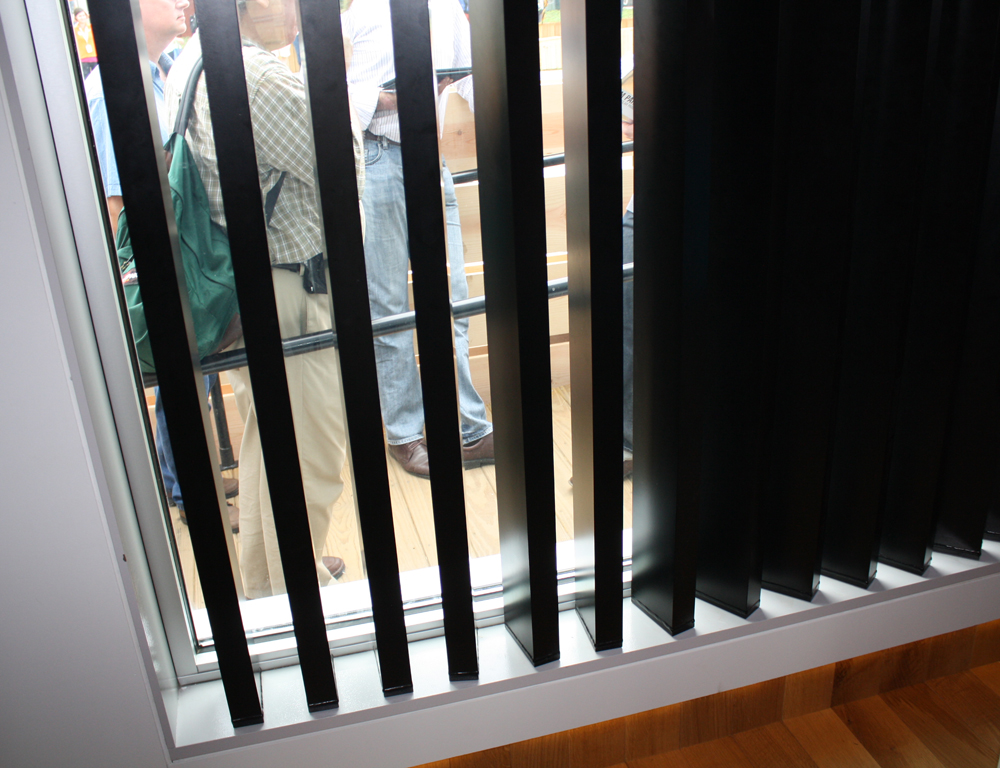
2.   Smart home controls:  It became apparent pretty quickly what really set this competition apart from previous years: the iPad.  Home automation systems were all the rage this year, with iPads, smart phones, HDTVs, and even a hacked Xbox Kinect providing a greater level of control of all the home’s systems.  Many of the teams wrote their own apps, controlling everything from the lights to the heating and cooling systems.  The SciArc/CalTech team developed a system that provided real-time energy use and controlled the shades.  The University of Illinois had a very impressive high-density display that even told you which windows were open.


3.   ERVs:  When you live in a very tight super-insulated home, mechanical ventilation becomes necessary to provide enough fresh air to all the habitable spaces.  Energy Recovery Ventilators take the heat energy from the exhaust air (in the winter) and transfers it to the incoming fresh air. (or the reverse in summer)  Most homes in the Solar Decathlon utilized an ERV, instead of the alternative: an HRV, or Heat Recovery Ventilator.  An HRV also exchanges heat energy between incoming and outgoing air streams, but an ERV has the added benefit of transferring moisture in the air.  By reducing the humidity level of the incoming air on this hot and humid September week in Washington, less demand was placed on the air conditioning systems, saving more energy. 

4.    Liquid dessicant dehumidification:  A couple of the houses sported decorative indoor water fountains that were more than just pretty pieces of art.  The University of Maryland developed an innovative Liquid Dessicant Waterfall system (patent pending) that uses a high-saline solution to absorb humidity from the air, reducing the load on the mini-split air conditioners.  The transfer of moisture happens vertically within this glass box and is displayed prominently as a design feature in the room.


5.   Home-grown food:  Many of the schools explored the true meaning of sustainability by providing a way for their occupants to grow and harvest their own food.  Normally this wouldn’t play into the energy-focused categories of the Solar Decathlon, but this year’s competition included a Home Entertainment category, in which each team had to throw 2 dinner parties for their neighbors.  This was a chance for the teams to show off their home-grown foods.

The New York team oriented its kitchen directly opposite large glass doors that open onto the outdoor roof garden, for easy picking at mealtime. The garden produces about 190 pounds of vegetables, about half of the resident’s annual consumption.

The Middlebury College house features a green wall in the kitchen and outdoor planters for growing vegetables and herbs.  In lieu of a brochure, visitors to the house received a packet of seeds.

The University of Maryland used composted waste as nutrients for food production in their vegetable and vertical gardens.

6.  Phase change materials:  In order to minimize unwanted solar gain, phase change materials [PCMs] are used to store heat energy and slowly release it at night. At the Solar Homestead by Appalachian State University, a modern Trombe wall consists of a plant oil mixture contained in a series of vertical fins.  In the evening, energy stored in these PCMs is released as the wax resolidifies and transfers its heat to the house.

In the mechanical room, phase change materials are also used to capture and store energy from a solar thermal skylight.  The hot water-glycol mix from the solar thermal system runs through tanks of paraffin wax, which stores about 50,000 BTUs of energy.  This setup replaces a traditional water heater.


7.   Adaptable furniture:  By the nature of the competition, smaller houses have an advantage because they contain less cubic space to heat and cool.  But each house has to include the required spaces and amenities.  As a result, the students tend to come up with some clever space-saving solutions. We saw sliding walls, pivoting panels, and adaptable furniture.

SciArc and CalTech designed a family of upholstered lounge seating that nests like a puzzle into the wall when not in use.  The University of Tennessee house featured a retractable bed that disappeared up into the living room wall cabinet.  And the University of Maryland house had a dining table that folded open into a bed.


8.   Micro-inverters:  With a solar PV array, an inverter is needed to convert the DC-current that is produced by the solar panels into the standard AC-current that is used in the home. Typically, a single inverter is used with a whole array of panels, but if one of the panels is shaded or dirty, its limited output will be reflected in the whole system.  Micro inverters are used so that each panel can operate at its maximum capacity.  Many of the schools used micro inverters, with one connected to every individual panel.  In this setup, each panel operates at its own peak level.

9.  Water Reuse:  The collection, treatment, and reuse of rainwater and greywater is an important aspect of many of the houses.

The outdoor planters of the SciArc / CalTech house are connected to the greywater system and are automatically watered based on weather forecast data.  WaterShed by the University of Maryland is designed with two sloping roofs that direct rainwater to a constructed wetland, where it is stored and filtered for reuse for irrigation.

10. PV solar shading:  Rather than being content to apply their solar panels to their roof, some of the teams elected to hold them off the house, creating secondary structures.  The University of Tennessee and Team Massachusetts  both created solar canopies in front of their buildings, which provided a shaded area outside, and cut down on direct solar gain hitting the windows of the front façade.  By removing the PV panels from direct contact with the roof, this also allows for ventilation on all sides.  This keeps the panels cooler and lets them operate more efficiently.

The best houses in the Solar Decathlon incorporated many of these products and features, and did so with consistency, harmony, and beauty.

There are only 2 days left until the final winner is announced.  To learn more about all the teams and follow the current rankings, go to solardecathlon.gov.

Tomorrow I’ll wrap up my review of the Solar Decathlon with a shorter list of my overall favorites.

Sep 19, 2011

Lead-up to the Solar Decathlon, Part 1

Posted by Matthew Bushey

This week marks the much-anticipated kickoff of the fifth U.S. Department of Energy Solar Decathlon competition, held on the National Mall in Washington D.C.  The event pits 20 teams of college students against each other to see who can design, build and operate the most energy-efficient, comfortable, healthy, affordable and beautiful solar-powered home.

From Sept 23rd until Oct 2nd, 19 homes will be built on the Mall and opened to the public for tours (the University of Hawaii dropped out). These are real homes, typically 800 to 1,000 square feet, that draw all of their energy from the sun.


I attended the first Solar Decathlon in 2002, and went again to the second one in 2005, to see firsthand the innovative designs and new technologies that these kids had come up with. This year, I will be returning to D.C. once again to see the Solar Decathlon, with a renewed sense of urgency, interest, and excitement.

Three weeks ago, Vermont was rocked by massive floods that caused widespread damage and attracted national attention.  It seemed we had just recovered from the spring floods and were taken by surprise by Tropical Storm Irene.  Elsewhere in the country, droughts are lasting for months on end and wildfires are burning at an unprecedented rate.  They say this is the ‘new normal’.  Warmer oceans are feeding stronger hurricanes, and the changing climate is leading to destructive weather patterns that threaten all of us.  With each passing year it becomes more evident that we need to speed up our efforts to power our buildings from renewable energy sources that decrease our greenhouse gas emissions.

The Solar Decathlon is showing the way.  For a quick description of the event, check out this Welcome and Overview video by the DOE:


This year, a Vermont school is participating in the Solar Decathlon for the first time. Middlebury College is on the Mall right now, assembling their first Solar Decathlon house, a 2-bedroom, 1,000 square foot home they call “Self-Reliance”. Unlike many of their competitors, Middlebury College does not have an accredited architecture program. In fact, Middlebury is the first ever liberal arts college to enter the Solar Decathlon alone. Its team consists of over 85 students from a variety of disciplines, working on the design, construction, and communication of Self Reliance.

I am really looking forward to seeing this house firsthand during the competition on the National Mall.  Check it out here: 


For more information on the Solar Decathlon, visit the official website at www.solardecathlon.gov. You can also follow the events on the solar decathlon facebook page, or on this here TruexCullins blog for more reports from a Vermonter’s perspective.

Jul 1, 2011

Flashback Friday: Sunpower Homes


It’s another Flashback Friday on the blog, with a look back at a project that was innovative in its time.

In 1975, Rolf Kielman and Terry Jacobs designed a series of homes that explored alternative methods of heating and cooling, aiming to reduce our dependence on foreign oil.  As we enter into this all-American holiday weekend, this project fittingly reminds us that we are still fighting for energy independence, 35 years later.


The Sunpower Homes, as they were called, were located in eastern Pennsylvania, just outside of Philadelphia.  They were speculatively built and were therefore designed to be very user-friendly for any future occupants.  The heating system did not rely on fluid collectors, which would have been more difficult to maintain for the untrained user and would have been susceptible to freezing in cold weather.  Instead, the homes utilized a more low-tech air panel system for the collection of heat which required less maintenance.

The rooftops were equipped with an 830 square foot active air panel collection system, as well as a domestic solar hot water collection system.  Air from the panels was ducted to a large rock box that filled the basement of the house.  This thermal mass retained the heat from the sun and subsequently distributed it throughout the house when it was needed.  If there was no call for heat, an exhaust system dumped the warm air to the exterior.  In the summer, the system was set up for cooling with the circulation of cool night air through the thermal mass, which drew heat out of the house during the day.

The active energy collection systems in these four homes were financed by a $19,000 grant for each house from HUD, the United States Department of Housing.

The homes also adhered to some basic principals of reduced size, improved thermal envelopes and effective siting and orientation.  All the houses were logically oriented to the south, with the major living spaces facing south and garage and service areas to the north.  Shading overhangs permitted the entry of the winter sun but blocked the warm summer sun.  The buildings had a minimal footprint and an effective building envelope insulated to a value of R-30.


Feb 16, 2011

Heritage Flight Week, Day 3

A Porous Parking Lot with a Monster Tank

We continue with Heritage Flight Week with a look at how this Aviation facility is dealing with storm water management.  For typical buildings, rainwater falls on the roofs, driveways and lawns and is channeled away: a valuable resource that is treated as a waste product.  At Heritage Aviation, 100% of the rainwater that falls on the site is captured, treated, and reused.

The south parking lot at Heritage is not your typical sea of asphalt.  This parking lot has a porous concrete surface that is designed to absorb all of the rain that falls on it,  eliminating the erosion and polluting affects typically caused by excess stormwater runoff.  The surface is capable of absorbing all the rainfall based on a 100 year storm.  At 87,117 sq. ft., this is the largest pervious parking lot in Vermont, and it is one of the largest in New England.

Runoff rainwater from the roof flows into a huge 35,000 gallon underground storage tank.  This includes rainwater from the high hangar roof and anything more than the 1" retained at the lower vegetated roof.  The captured rainwater is then used for landscape irrigation and for washing aircraft.

The last piece of the puzzle is a bioswale (rain garden) stormwater collection area that captures any remaining rainfall, when the underground storage tanks are full.  All of these strategies together fully protect the site from storm water runoff and foreign contaminants.


Feb 15, 2011

Heritage Flight Week, Day 2

A Green Roof, best viewed from above

For a facility that is located at a major airport, the view of the building from the sky is often appreciated just as much as the view from the ground.  Passengers flying with Heritage Flight, as well as those travelling on commercial airlines out of Burlington Airport, have a clear view of the roof of Heritage Aviation.  And this roof is very “green”, in more ways than one.

The roof is home to a 10-panel 65.2 MBtu solar thermal domestic hot water system and an adjacent 120-panel 25.2 kW solar photovoltaic array.  The upper roof of the main hangar is finished with a highly reflective white membrane that reduces solar heat gain.  But the most striking surface on the top of the building wraps around 3 sides of the upper roof.  This lower level features a 13,742 sq.ft. "green" roof, with several varieties of sedum covering the surface of the building like a lush canvas.  The colorful plantings are arranged in a waving pattern and can be seen from the rooftop observation deck or from the air as you fly overhead.

The vegetated roof retains the first 1" of rainfall that falls on it, with the excess directed toward underground irrigation tanks.  When installed, this was the largest green roof in New England, and it remains today the largest in Vermont.


Feb 14, 2011

Heritage Flight Week, Day 1

The Nation’s First Airport Wind Turbine

Today we kick off a 5-part series on one of our most recent success stories.  This is Heritage Flight Week on the Truexcullins blog!  …It’s kind of like Shark Week, only instead of watching Discovery Channel shows on the most fearsome predator of the sea, you will be diving into a new aspect, each day, of the Heritage Flight Aviation facility at the Burlington International Airport.


The project started with the complete reconstruction of a vacated 1954 hangar.  The original structure was formerly occupied by the Vermont National Guard and has since been repurposed and transformed into a 75,800 sq. ft. aviation services facility.

The building has been open for about a year now, and we just received word from the USGBC that the project has been officially granted LEED Gold Certification.  This is the first LEED Gold aviation facility of its kind in the country, and as you’ll see over the next week, there are a lot of good reasons why it earned this top prize.

One of the most visible signs of its environmental excellence is the 100 Kilowatt commercial wind turbine standing tall at the southeast corner of the parking lot, with a blade diameter of 21 meters. According to Heritage Aviation, they are generating 15% of their energy needs, saving 200 kW Hours per 10-hour daytime shift every day, with most of that power coming from the wind.

What is most notable here is that this FAA-approved wind turbine is the first community-scaled wind turbine installed at a general aviation facility in the United States. In the past, concerns about possible visual interference with air traffic control or flight patterns may have prohibited the siting of wind turbines at airport locations, but this installation marks a turning point in the attitude toward renewable energy and the acceptance of wind energy technology (at least on the part of FAA regulators).

Jan 25, 2011

A Sustainable Vocabulary

posted by Matthew Bushey, AIA, LEED AP

The topic of sustainability has always been a heated source of discussion among architects and designers, but the recent conversation has shifted to the use of the word itself.  This is in part a reaction to the fact that Advertising Age recently named the word sustainability as one of the top ten “jargoniest jargon” words of 2010.

This is what they had to say about this ubiquitous term:
 A good concept gone bad by mis- and overuse. It's come to be a squishy, feel-good catchall for doing the right thing. Used properly, it describes practices through which the global economy can grow without creating a fatal drain on resources. It's not synonymous with "green." Is organic agriculture sustainable, for example, if more of the world would starve through its universal application?

The commonly understood definition of sustainability is, if I may paraphrase, that which provides for the present without compromising the future.  Or, more precisely: that which meets our needs in the present without compromising the ability of future generations to meet their needs in the future.  Still, it is a broad definition because sustainability applies to so many different interrelated issues.  We have thus layered it with so many additional meanings that it has essentially become meaningless.  We speak of sustainable architecture, sustainable food, sustainable energy, and if you can believe it, sustainable growth.  (Can growth really be sustainable?  Or is true sustainability only found in equilibrium?)

But let’s get back to architecture.  The folks at Ad Age are correct in pointing out that sustainability is not synonymous with “green”.  This is a distinction that is not always recognized.  Upon first blush, it would seem that green architecture is simply a subset of sustainable design.  It’s a matter of degree: green architecture decreases its environmental impact, while sustainable architecture dramatically eliminates its environmental impact.

However, it’s not always so.  Like the example of organic agriculture, the architecture industry has its own “green” practices that are not necessarily sustainable: the use of petroleum-based insulation, for example.

Clearly, Green design is a more easily understood concept.  Green is eco-friendly.  It’s environmentally preferable.  Sustainable design, on the other hand, is burdened with ever more complicated sub-definitions and concepts like net-zero energy, passive house design, and biomimicry, to name a few. 

There is another term that perhaps better articulates the concept of environmentally conscious design:  sufficiency.

To be sufficient is to be satisfied, but without excess.  It rejects greed and overindulgence, and focuses on just what is necessary for a comfortable survival, whether in the house you build or by the food you eat.

To take it one step further, I would offer up the concept of self-sufficiency:  relying on no one but yourself for what you eat or how you live.  There are no negative impacts on others, because you are not relying on others for your own survival.  Put in these terms, the concept of self-sufficiency has an intrinsic appeal to our adventurous, independent spirit, something we proudly associate with as Vermonters and as Americans.

Advertising Age says sustainability is a word they “wish you would stop saying”.  I don’t disagree that the word has become overused, misrepresented, and indeed stripped of all meaning.  But I hope that in spite of the backlash, the conversation can continue.   Instead of dropping the word – and the subject – from our vocabulary, let’s explore other ways to communicate the concept of living and building in environmentally beneficial ways.

Jan 11, 2011

Villa Verde Vermont

Building a house can be a deeply personal and consuming project.  It can be exhausting, it can seem neverending, but it can also be one of the most rewarding endeavors you ever take on.

Many of us have tackled renovations of varying degrees of scope, from a single room to a whole-building gut reno.  But building your own house from the ground up opens up whole new opportunities.  It's a chance to fulfill dreams and change lives.  It's an opportunity that usually comes along just once in a lifetime.

Some who embark on this challenge choose to share the adventure by recording each step of the process online.  You can find a few very good blogs by (future) Vermont homeowners who are documenting their construction adventures and posting photos of their home as it slowly takes shape.  If you're thinking of making your own dreamhouse someday, these blogs are a good source of ideas, advice and inspiration.

Tina and Michael are two of our clients who are currently building their own home about 20 minutes outside of Burlington.  They've been recording the process since January 2010 on their blog: Villa Verde Vermont.  The modern home is designed by Rolf Kielman, with landscape design by Keith Wagner.  Currently, the house has been framed and the exterior siding is going up.

You can follow the progress as the house gets closer to completion with each passing day.  As they put it: A modern/minimal design, we're including as many "green" and energy-efficient elements as our budget will allow.

Nov 24, 2010

Passive House design comes to Vermont

Posted by Rolf Kielman, AIA, LEED AP

The Passive House: it sounds like some kind of strategic mind game for buildings. In actuality, this is a very positive development for designing better buildings.

In the quest for more knowledge about these passive houses, I spent last weekend with Marc Rosenbaum at the Yestermorrow Design-Build School. The course he was teaching dealt with the comprehensive process involved in the design of Passive House. The Passive House is a rigorous process for ensuring dramatically improved energy performance. This process has been stringently refined by (who else?) German design professionals. It is applicable to larger scale buildings as well, and many European structures are being built to these standards.

The continued increase in world-wide energy costs has led to higher performance expectations for the buildings we design. The Germans and the Japanese have established standards that mandate a low level of energy consumption per square meter of building area. These standards will soon be coming to North America. I would not be surprised to ultimately see performance criteria established for our buildings much as we already have mileage criteria for automobiles.

During the 1970s, I (and many others) designed low energy homes. These homes often had renewable energy collection systems and were either super insulated or double envelope houses. At the time, we did little to rectify air leakage or utilize much more than the crudest methods to measure building performance. Nevertheless, those buildings became the precedent structures that our design colleagues around the world are now emulating and improving on.

The principal behind the making of Passive House is simple: provide houses (or any building) with an exceptional thermal blanket. So exceptional, that all one might need to heat the house is a single candle or some form of minimally fueled heating device. The higher cost of fuel has spurred the European Communities to accelerate their quest for the more “perfect” building. Many of us in North America are again in quest of this perfection.

A Passive House is more than just an ultra thick blanket of insulation, however. The “blanket” must be designed to minimize air leakage, and as we all know, it can get stuffy under a blanket that doesn’t offer some modicum of ventilation. Enter an effective ventilation system that supplies fresh outdoor air. Ventilation is essential, but when we ventilate in our cold climate we dump lots of warm, stale air into the winter night. So, we ventilate with what is called an energy or heat recovery ventilator. In slightly more moderate climates (such as much of Germany), an ERV is about all that’s needed to heat a super-insulated and non-leaky home.

Here in northern Vermont we need a little extra heat, and this can be provided by an electric heating coil placed within the ductwork of the ERV. Or, if a little romantic bio-fuel is desired, one could install a pellet or wood stove, perhaps with a hot water coil on the back to provide supplemental hot water for showers and washing dishes. Increasing in popularity is a mini-split air-to-air heat pump. These devices extract heat from outside air and add it to your interior heating needs. The advantage to these little babies is that they can run in reverse in summer and help cool your house. This device runs on electricity as well. It should be stressed that the heat load, even in our climate, is minimal. For the electric heating coil or heat pump, a photovoltaic array on the roof would supply the electricity required for the coil/pump as well as supplying additional renewable power for your home’s lighting and electrical needs.

I believe the idea behind passive House is sound. Spend a little extra money on the building envelope and save money on the cost of a heating plant and distribution system. The Passive House has fewer moving mechanical parts and very high overall building performance. Save money on heating fuels (the cost is only going up), and dump less carbon into the air. All is good.

A couple of other points worthy of discussion: with a sound building envelope, fresh air supply and a modest heating source, we still need natural light to live and grow. While windows are vastly improved with regard to thermal effectiveness, they still fall far short of a well-insulated wall. So Passive House logically places windows on the south side with more modest amounts of glass on the east, west and north. A good window on the south side of our houses, even in the Vermont winter, is still a net heat gain, so this glazing contributes heat to the house’s needs.

Passive House is a great idea. The certification process looks complicated, but the design and calculation principals are sound. A good rule of thumb is keeping the shape of your home straightforward… even box-like. Think of our ancestors who populated much of the New England landscape. Their buildings were remarkably straightforward and often the more elegant for that simplicity. That simple beauty lies at the root of our building traditions and Passive House seems like an idea that New Englanders will embrace.